How to Stop Anxiety From Killing Your Erection

You’re attracted to your partner, the moment feels right, and you want to be intimate. But instead of settling into the experience, your attention jumps to questions like: Will everything work? What if it does not? What will my partner think? That kind of mental spiral can pull you away from arousal before your body has a chance to respond.
Performance anxiety is not “just in your head.” It can set off a real stress response that works against the physical conditions needed for an erection. In a population-based cohort study of men ages 18–40 with ED, researchers found that depression and anxiety diagnoses were more common in the 12 months before ED diagnosis compared with matched controls: 17.1% vs. 12.9%. The same study also found higher rates of new depression and anxiety diagnoses after ED diagnosis, highlighting how sexual function and mental health can influence each other.
The goal is not to force yourself to “perform” on command. It is to reduce the pressure, support your body, and build conditions that make arousal easier to access. For some men, that means stress-management skills and partner communication. For others, it may also include medical guidance for the physical side of erectile function.
Key Takeaways
- Anxiety can shift the body toward a stress response, which may make erections harder to achieve or maintain.
- Mental health and ED can overlap: one large study of young men with ED found higher rates of depression and anxiety than in matched men without ED.
- Mindfulness, cognitive reframing, and communication can help reduce the self-monitoring that fuels performance pressure.
- PDE5 inhibitor medications may support the physical side of erectile function when prescribed by a healthcare provider.
- Sleep, exercise, stress management, and substance choices can all influence both anxiety and erectile function.
Understanding the Link: How Performance Anxiety Affects Erections
Erections depend on coordination between the brain, nerves, blood vessels, hormones, and emotional state. When you feel relaxed and sexually stimulated, the body can shift toward the parasympathetic “rest and digest” state that supports blood vessel relaxation and penile blood flow.
Anxiety can push the body in the opposite direction. Instead of tuning into sensation, the brain starts scanning for danger: What if this happens again? Am I disappointing my partner? Is my body responding fast enough? That threat-monitoring can make it harder to stay physically and mentally engaged.
The Neurological Conflict
Performance anxiety often creates a mismatch between what you want and what your nervous system is preparing for. You may want closeness and arousal, but your stress response may be preparing for protection and control.
That can look like:
- Faster, shallower breathing
- Muscle tension
- Racing thoughts
- Self-monitoring instead of sensation
- Difficulty relaxing into arousal
- Worry that builds before intimacy even starts
This does not mean desire is absent. It means stress may be competing with sexual response.
The Feedback Loop
Anxiety-related ED often becomes self-reinforcing. One difficult experience can make you more alert for the same problem next time. That anticipation increases pressure, pressure increases stress, and stress makes the body less cooperative.
The loop can start from many things: fatigue, alcohol, a new partner, relationship tension, or a random off night. The key is not treating one experience as proof that something is permanently wrong. The more you can interrupt the loop early, the easier it becomes to rebuild steadier expectations.
Identifying Triggers: What Causes Performance Anxiety in the Bedroom?
Understanding your specific trigger pattern helps you choose the right strategy. Some men feel anxious before intimacy begins. Others only start spiraling after noticing a change in erection firmness or timing.
Common Psychological Triggers
- Past difficult experiences: A previous erection problem can become a mental reference point, especially if it happened during a high-pressure moment.
- Fear of being judged: Worrying about your partner’s reaction can shift attention away from pleasure and toward evaluation.
- Relationship tension: Unresolved conflict, emotional distance, or poor communication can make physical vulnerability feel harder.
- Self-monitoring: Constantly checking whether your erection is “good enough” can become distracting enough to interfere with arousal.
- Body image concerns: Feeling self-conscious can make it harder to relax, receive touch, or stay connected to sensation.
Contributing Factors
Several everyday factors can make performance anxiety more likely:
- Heavy workload or major life stress
- Poor sleep or inconsistent rest
- Alcohol before sex
- A new partner or unfamiliar setting
- Pressure after time away from intimacy
- Health worries or medication concerns
These factors do not always cause ED on their own, but they can lower your mental and physical margin for stress.
Breaking the Cycle: Strategies to Overcome Performance Anxiety
The best starting point is usually simple: lower the pressure and give your body cues that the moment is safe. That often works better than trying to force arousal through willpower.
Mindfulness and Presence Techniques
Mindfulness helps you notice anxious thoughts without immediately treating them as instructions. Instead of arguing with the thought, you practice returning attention to what is happening now.
Try these options:
- Spend a few minutes breathing slowly before intimacy, with extra attention on a longer exhale.
- During intimacy, choose one physical anchor: warmth, pressure, breath, sound, or touch.
- If worry shows up, silently label it: “That is anxiety,” then return to sensation.
- Focus on one part of the experience at a time instead of trying to evaluate the whole encounter.
The point is not to clear your mind. The point is to stop letting worry lead the entire experience.
Cognitive Reframing
Cognitive-behavioral strategies can help you test and soften the thoughts that drive anxiety. A review of cognitive-behavioral treatments for anxiety describes cognitive restructuring as a way to identify thinking traps and build more balanced interpretations.
Examples:
- “If I lose my erection, the night is ruined” becomes “We can slow down, reconnect, and still have intimacy.”
- “My partner will think I am not attracted to them” becomes “I can communicate what is happening instead of letting them guess.”
- “This always happens” becomes “This has happened before, but it is not the only possible outcome.”
- “I have to prove myself” becomes “I can focus on shared pleasure instead of a performance test.”
Reframing does not mean pretending everything is fine. It means giving your brain a more accurate script than the worst-case version.
Communication With Your Partner
Performance anxiety grows in silence. When your partner does not know what is happening, they may misread your stress as disinterest, rejection, or lack of attraction. A short conversation can remove a lot of that extra pressure.
Try saying:
- “I’m attracted to you, but sometimes I get in my head and it affects my body.”
- “It helps me when we slow down and do not make intercourse the only goal.”
- “Can we focus on touch and closeness tonight instead of trying to force a specific outcome?”
This does not need to become a long or heavy conversation. The goal is to reduce guessing and create a calmer environment for both of you.
Beyond Anxiety: When to Consider Medical Support
If anxiety-related ED keeps repeating or starts affecting your relationship, it may be worth talking with a healthcare provider. A provider can help rule out physical contributors, review medications or health conditions, and discuss whether ED treatment is appropriate.
Recognizing When to Seek Help
Consider medical guidance if:
- Erectile difficulties persist or become more frequent
- The issue happens across different situations, not only during partnered sex
- You have health conditions such as diabetes, high blood pressure, or cardiovascular concerns
- You take medications that may affect sexual function
- Anxiety around sex is causing avoidance or relationship strain
Psychological factors and physical factors can overlap, so a medical review can help clarify what is actually going on.
The Role of Medication in Breaking the Cycle
PDE5 inhibitors such as sildenafil, tadalafil, and vardenafil are designed to support blood flow when sexual stimulation occurs. They do not create automatic erections, and they do not replace desire, communication, or arousal.
For anxiety-related ED, medication may help by reducing uncertainty around the physical response while you work on the mental side. That can make it easier to practice slower pacing, communication, and present-moment focus without feeling like everything depends on willpower alone.
Lifestyle and Wellness: Supporting Your Sexual Health
Daily habits can influence both anxiety and erectile function. These changes are not instant fixes, but they can support the conditions your body needs for steadier sexual response.
Sleep and Recovery
Sleep affects mood, stress tolerance, hormones, and sexual function. A 2026 review on sleep stages and erectile function describes erectile function as closely tied to sleep physiology, including REM sleep and autonomic regulation.
Helpful steps include:
- Keeping a consistent sleep and wake schedule
- Limiting late-night screen use
- Reducing alcohol close to bedtime
- Creating a dark, cool sleep environment
- Talking with a provider if snoring, gasping, or daytime fatigue suggests a sleep disorder
Exercise and Physical Activity
Regular movement can support circulation, mood, and stress regulation. Cardiovascular exercise may be especially useful because erections depend heavily on healthy blood flow.
Start with a realistic target you can maintain. A brisk walk, cycling, swimming, or strength training routine can all help build a stronger foundation over time.
Stress Management
Chronic stress can keep your body on alert, which makes it harder to access relaxation and arousal. Choose stress tools you will actually use:
- Short breathing breaks between work and home life
- A walk after stressful meetings
- Journaling before bed
- Therapy or coaching if anxiety feels difficult to manage alone
- Clearer boundaries around work, phone use, or conflict-heavy conversations
Substance Considerations
Alcohol may feel like it lowers anxiety, but it can make erections less predictable. Smoking and nicotine can affect blood vessels, which can matter for erectile function. Reducing or avoiding these triggers may make sexual response more consistent.
How BlueChew Can Support Your Confidence
When performance worry keeps taking over, BlueChew may help address the physical side of ED through provider-guided prescription options.
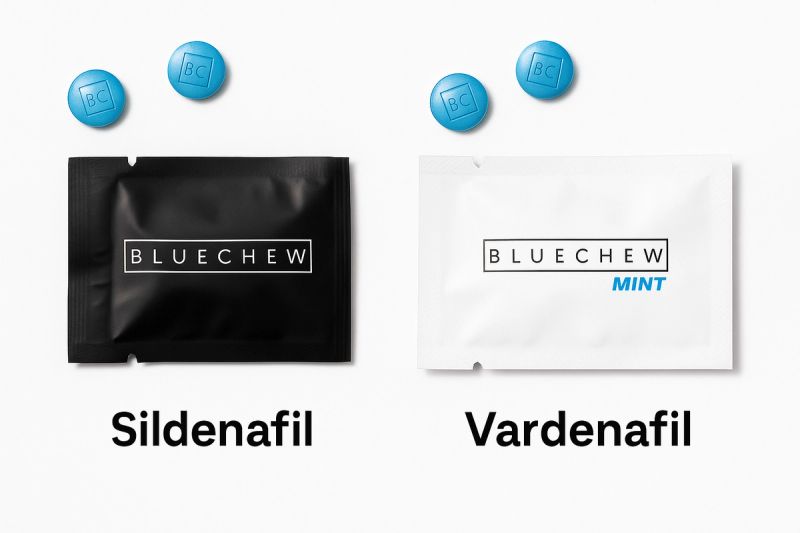
BlueChew provides compounded prescription medications containing the active ingredients sildenafil, vardenafil, and tadalafil. Sildenafil, vardenafil, and tadalafil are the active ingredients in Viagra, Levitra, and Cialis, respectively. BlueChew offers chewable, sublingual, and liquid medication options across its complete lineup.
For men dealing with performance anxiety, longer-lasting options may help reduce timing pressure. GOLD combines sildenafil and tadalafil with oxytocin and apomorphine in a sublingual tablet that may be worth discussing with a provider.
BlueChew's complete product lineup includes:
- SIL: 30 mg or 45 mg sildenafil, from $2.95/tablet, works in 15 minutes, lasting up to 6 hours
- TAD: 6 mg or 9 mg tadalafil, from $3.58/tablet, effective within 15 minutes, lasting up to 36 hours
- VAR: 8 mg vardenafil, from $4.34/tablet, takes effect in 15 minutes, lasting up to 6 hours
- DailyTAD: 9 mg tadalafil plus 7 essential vitamins, $2.23/tablet, lasting up to 36 hours
- MAX: 45 mg sildenafil + 18 mg tadalafil combo, $5.63/tablet, lasting up to 36 hours
- VMAX: 14 mg vardenafil + 18 mg tadalafil combo, $5.63/tablet, lasting up to 36 hours
- GOLD: sildenafil, tadalafil, oxytocin, and apomorphine sublingual tablet, from $7.30/tablet, lasting up to 36 hours
Frequently Asked Questions
Can anxiety alone cause erectile dysfunction?
Yes, anxiety can contribute to erectile difficulties even when desire is present. Stress can shift attention toward monitoring and away from sensation, while also making relaxation harder. That combination can interfere with the physical response needed for an erection.
How long does it take to overcome performance anxiety ED?
Timelines vary. Some men improve with communication, stress management, and more relaxed sexual pacing. Others need support from a healthcare provider, therapist, or both. It is better to measure progress by reduced fear, more open communication, and fewer avoidance patterns rather than by a fixed number of weeks.
Will PDE5 inhibitors work if my ED is caused by anxiety?
They may help if a healthcare provider determines they are appropriate for you. PDE5 inhibitors support blood flow when sexual stimulation occurs. For anxiety-related ED, they may be most useful when paired with strategies that address the worry, pressure, and self-monitoring behind the cycle.
How do I know if my ED is psychological or physical?
Signs of a psychological component can include sudden onset, erections during masturbation or upon waking, and difficulties that happen mainly in partnered or high-pressure situations. Physical ED may be more consistent across situations and can be linked to medical conditions, medications, or vascular health. Many men have a mix of both, so provider guidance is helpful.
What can my partner do to help with my performance anxiety?
A partner can help by keeping the focus on closeness rather than a single outcome, slowing the pace, and avoiding pressure-filled reassurance. It can also help to agree that intimacy does not have to end just because an erection changes. The more both partners can stay calm and flexible, the less power the anxiety loop tends to have.
This article is provided for informational purposes only and does not constitute medical advice. The information presented is not a substitute for professional medical advice, diagnosis, or treatment. Always consult your healthcare provider to discuss the risks, benefits, and appropriateness of any treatment.
BlueChew offers access to healthcare providers who may prescribe compounded medications for the treatment of erectile dysfunction.
The featured products include compounded medications that have not been approved by the FDA. Compounded medications may be prescribed under federal law but are not the same as, nor are they generic versions of, any FDA-approved medication. The FDA does not review compounded medications for safety, effectiveness, or manufacturing quality of compounded products. A prescription will only be written if deemed appropriate after the digital consultation by the licensed medical provider. Individual results may vary.
BlueChew is not a compounding pharmacy but a telemedicine service that links patients to licensed medical providers.